It All Counts (Weeks 4&5 - Hanoi & Ha Giang)
Content Warning: Discussion of Torture

Let me set the scene for the beginning of my time in Vietnam:
The morning of my flight to Hanoi, the first thing I saw when I opened my eyes was three bug bites in a line on my foot. All too familiar with that pattern from my fiasco in Seoul, I immediately knew that I had gotten bedbugs again - or perhaps I had never lost them in the first place. Either way, I needed to quarantine and deep clean everything, and make damn sure that I was finally rid of these bloodsucking hitchhikers.
That morning, I immediately stuffed everything that was possibly contaminated into a trash bag, purchased a cheap knockoff duffel in the Taipei subway station to hold said trash bag, and stowed it in the overhead on my flight to Hanoi. If anyone on the Vietjet flight to Hanoi on the evening of December 8th, 2024 has bedbugs now, I truly apologize. I did the best I could in the circumstances.
After landing in Hanoi, I was exhausted, carrying half my possessions in a bedbug infected duffel bag in my left hand and the other half on my back in a hopefully bedbug uninfected 50 gallon backpack, with a small knockoff briefcase in my right hand that I had purchased to carry my computer, visa, and medicine. When I stepped outside, I accepted the first offer for a taxi I saw. I followed the man as he beckoned me through the throng outside the arrivals terminal.
We pushed through person after person in the midnight crowd. He turned to me and asked to hold my duffel bag, and I sleepily, mindlessly handed it to him. After this I followed closely in his wake as he pushed through the crowd waiting for taxis, then past the crowd to the line of taxis, and finally past the line of taxis. He turned to me and said, “Where are you from?”
“America,” I said, “Tennessee. You know, like Johnny Cash,” I said. People always know Johnny Cash.
He summoned a tight smile and turned his head back around, walking faster, further into the darkness, away from the crowd. “Alright,” I thought to myself, “not a Johnny Cash fan.”
It was at this point, as we were walking through the curiously dead area between the end of the taxi line and the highway, that it dawned on me that I had made several boneheaded decisions in a row. I had accepted a ride from an unofficial taxi hawker, then allowed him to take my personal belongings in his hand, then told him that I had one of the most valuable passports in the world on my person, all while following him to a dark area behind all the cars. Our differing taste in music was suddenly much further down my list of concerns.
No sooner did this thought enter my head then a taxi pulled up, and he threw my duffel bag in the back. “Ah,” I figured, “he was a hawker and this is just the guy he’s guiding me to.” The taxi at least had proper registration posted in the window, so I hopped into the back with my backpack and cheap briefcase, although I did briefly think that it would likely be safer and funnier to leave them with just my bag full of bedbugs while I ran back to arrivals.
This relaxation was undercut when the hawker jumped into the passenger’s seat, and we sped off, past the line of taxis, and onto the surface roads that led away from Hanoi airport. At this point I was on high alert. Two men, who I fairly confidently thought were running some sort of scam, had me in the back of the car, with my luggage in the trunk, while I, my passport, and my highly valuable kidneys sat in the backseat. I briefly considered tucking and rolling out of the car, but quickly realized that we were going too fast for that to be a real possibility.
As we drove up to a checkpoint that led out of the airport, I quickly tried to position myself in the back so I could communicate with the employee working in the booth. Just as it looked like we were pulling up, the car veered off to the right, and both the driver and passenger opened their doors, got out of the car, and darted towards each other.
“This is it,” I thought to myself, “They are going to steal my passport and / or my kidneys.”
I grabbed my backpack and briefcase, opened the back door, and hopped out, popping up ready to swing at them or make a break for it. Just as I whipped my head towards the front of the car to see if they had any weapons, the two men looked at me, stunned, and then burst out laughing. They shook hands, and the driver jogged off to a parking lot while the passenger circled over to the car door. After all that stress, they were just doing a shift change on the taxi.
Let me make this clear - I am an idiot. Do not do what I did under any circumstances. Fortunately though, neither my kidneys nor my passport were taken from me, just an extra $20 for a bogus “highway fee”. If the worst scam I got suckered by in my time in Vietnam is that I accidentally paid the American price for a cab ride instead of the Vietnamese price one time, then I figure I’m doing alright.
When I got to the hotel, I threw my luggage on the balcony and set to work quarantining and decontaminating. The first order of business was to get new clothing that I could reasonably suspect to be 100% bedbug free, which meant going on a mission to a nearby Uniqlo. I would once again like to apologize to the citizens of the Socialist Republic of Vietnam if any of them have since gotten bedbugs in the Hoan Kiem Uniqlo - my options were limited. After I was told that I was not permitted to change into the clothes I had purchased in the changing room, I went back to my hotel and sped walked through the hotel room to my fourth floor balcony. I stripped out of all my potentially infected clothes in the open air, hugging my back to the sliding glass door to minimize my visibility from the street, murmuring a simple mantra: “Nobody ever looks up, nobody ever looks up.”

The next several days were spent systematically taking garbage bags full of whatever I could carry inside, carefully inspecting them, and heat treating them. After contracting out a laundry service for all my washable bags and clothing, burning my arm by pouring boiling water into my shoes, and steaming the entirety of my big bag (again), I left everything inside, and slept, waiting to see if I would awake to any more bites.
Waking up felt like the worst Christmas morning of all time. Bedbug Santa didn’t come to visit, and I was happy simply not having any more coal in my stocking. I spent the rest of that day resting. I ordered a cheap pizza for delivery, and then spent the rest of the day under the covers while my feet finally recovered from the blisters, bedbug bites, and mild frostbite I had acquired in Korea.
The next day, I had recovered enough to explore Hanoi. Hoa Lo prison was a five minute walk from my hotel. Many Americans are familiar with Hoa Lo prison, although they are far more likely to know it as the “Hanoi Hilton”, the place where captured American pilots were kept after they were shot down while bombing North Vietnam. What fewer Americans know is that it was also the maximum security prison where the French kept Vietnamese political prisoners before the collapse of French Indochina. Now, the prison is a museum dedicated primarily to how the French ran the prison.
It was difficult to witness. The Vietnamese nationalists who were kept there would be kept shackled to their beds, dozens to a room. In the women’s prison, it was common for children to be imprisoned with their mothers. Disobedience was punished. Hunger strikes and nudity strikes were often used to express discontent with living conditions, but these were often met with billy clubs and fire hoses by the French guards. For those deemed to be leaders of the Nationalist movement or particularly egregious offenders against the peace of Hoa Lo, more extreme forms of torture would be used. Sometimes they would be shackled on an inclined floor with their feet up, causing blood and fluids to pool in their torsos. Amputation would be necessary in some cases due to the lack of blood flow to the extremities. Other times, the French would refuse to clean the shit buckets the prisoners used as punishment, making the already cramped living conditions unbearable pits of disease. One room in the prison simply recounted all the forms of torture that the French would use, with nauseating passages reprinted discussing how to best endure electrocution.
In a stereotypically French twist on colonial cruelty, they would often use a guillotine for their executions. The guillotine currently located at Hua Lo would be disassembled and reassembled just to have political prisoners executed in their own hometown. After all, by French logic, political dissent would be most effectively dissuaded if the friends and family of those executed could see the consequences of their actions. In reality this had the opposite effect. Many more Vietnamese nationalists were created by these displays of French power. However, the French often forgot to view the Vietnamese as human. If they had, perhaps they wouldn’t have provoked them over and over. Then again, if they viewed the Vietnamese as human, there would only be a small handful of French policies in their colony that would have remained the same.

Ironically, and surprisingly to an American audience, Hoa Lo prison goes out of its way to praise American GI’s. I was shocked to see how the plaques immediately and repeatedly say that American soldiers were simply doing their best in a war that they didn’t create, even the pilots conducting the bombing raids of North Vietnam. Nixon and Kissinger are essentially portrayed as Satan figures - and fair enough - but the message given over and over is that the American troops were simply there fighting their half of the conflict.
My mind went back to when I told a man that I was backpacking in Vietnam in the bar I was working at back in Nashville. He told me that he was a Vietnam veteran, and then said, “Well I’ll tell you what, we fought the shit out of the Vietnamese, they fought the shit out of us, but when you go there today they’re some of the best people around.” The attitude expressed by that veteran appears to be somewhat mutual between America and Vietnam. If there is any asymmetry, it exists on the Vietnamese side. The attitude in Vietnam towards America and American citizens is overwhelmingly positive - a 2015 Pew survey found that 76% of Vietnamese citizens held a favorable opinion of the United States.
The next day I went out on a food tour with Lucky, a local guide who was recommended to me by Isabel. As we sat on a miniature stool, eating a bowl of mung bean sticky rice, Lucky told me about his grandmother. The French massacred her village when she was just a pre-teen, at which point she joined the resistance to French colonialism. She fought for decades to ensure the independence of Vietnam. When the war was over, she was offered a large tract of land, but opted instead to stay in her tiny little apartment in the middle of Hanoi. Once, a burglar broke in, and pointed a knife in her face asking where the money was hidden. She grabbed the machete that she always kept underneath her pillow and sliced his hand clean off, chastising him not to scream because she would wake her grandchildren who were sleeping in the next room over. She could do pull ups into her 90s and passed away in her 100s. I double checked this information. If I got any of it wrong she would rise from the grave and kick my ass.
The tallest place in Hanoi is the Lotte Tower, a clear sign of Vietnam’s liberalization since the end of the Cold War. A Korean megacorp owns the Hanoi skyline. There are no hammers and sickles to be found in the luxury mall lined with marble.
To get to the top of the tower, I had to go down through the parking garage, through the checkout of a grocery store, and through a dark tunnel, before coming out the other side to a neon and fluorescent lit room. From there, I purchased a ticket and took the express elevator to the interior observation deck. Reader, to be frank with you, the vibes were horrendous. Nelly’s “Hot In Herre” blasted at too loud of a volume as I stepped off the elevator, echoing through a completely empty observation deck. There’s always a certain tragedy when dance music is played without anyone dancing, but as I rounded the corners of the observation deck and saw the employees standing around, wearing clean, pressed suits and expressions of boredom, I was acutely aware that I was at a party where I was the only attendee.
I still had a coupon for a free drink that came with my ticket though, and I was damn well going to use it. I was guided by a nearby employee to a couch at the edge of the floor with a gorgeous view of the Hanoi skyline and was handed a glass of Scotch. At this point the soundtrack had moved on to Chingy’s “Right Thurr”. I felt grateful to have such an authentic experience of Vietnam.
Eventually, some people did file in for the bar’s happy hour. When I finally pulled my attention away from my Scotch, I noticed that the vibes had not gotten any better. Directly in front of me, a man surreptitiously grabbed his date’s breast underneath her puffy white coat. To their right, an influencer set up a tripod to record himself in what was no doubt a paid spot by the bar. Business groups came in, already drunk from a night on the town. The worst aspect of all of this was the televisions that were all around, either displaying ads, Kpop music videos with no audio, or, worst of all, AI images where I can only guess that the prompt was “Elderly tattooed Asian women wearing bikinis” or, occasionally, “Tattooed Asian women wearing bikinis underwater.” I don’t know whose fetish that was. I only know that I wish that they had been kept out of the design process entirely, preferably by gunpoint.
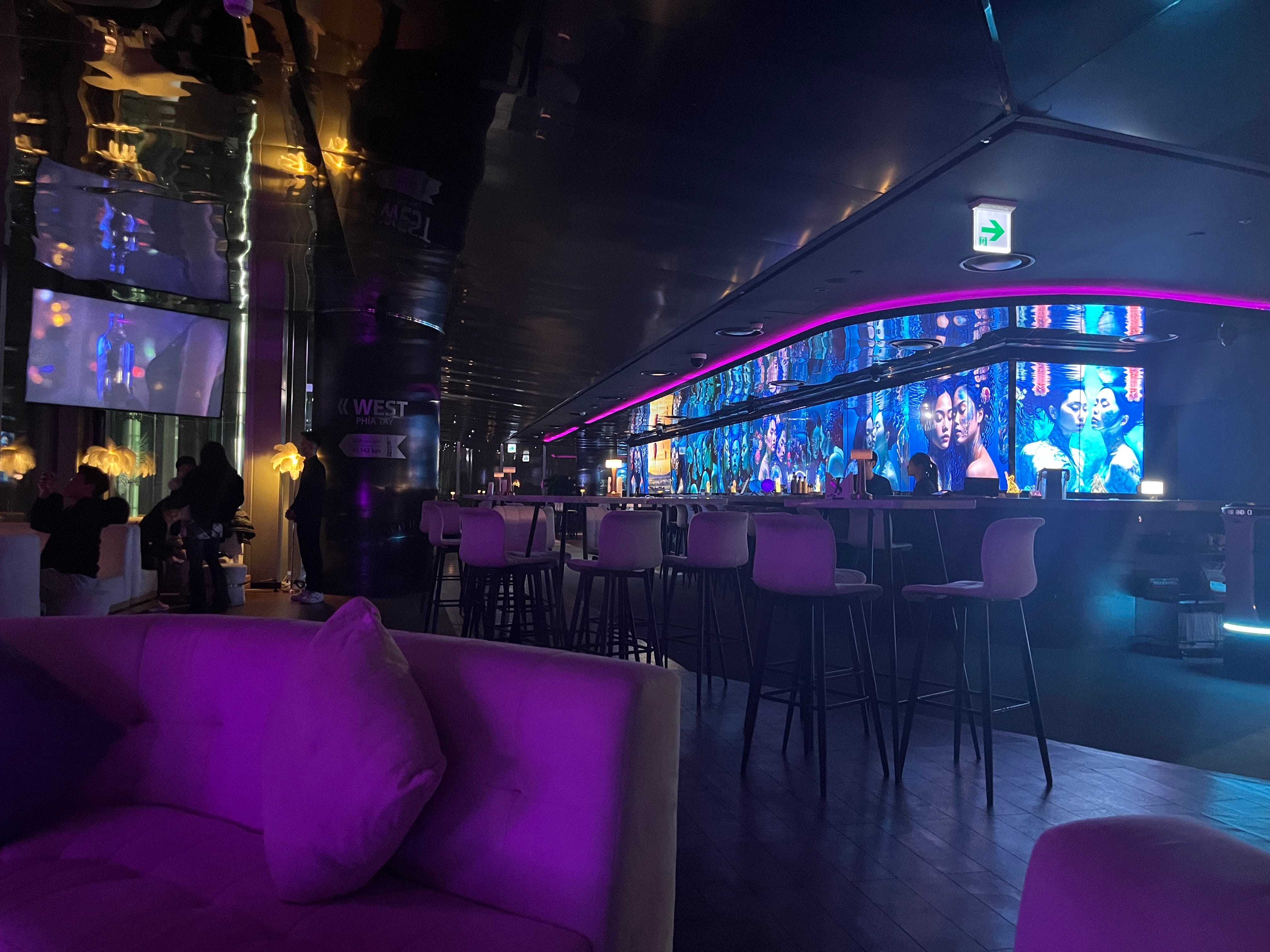
The one saving grace was that the employees truly did not give a fuck. There were easily twice as many employees as guests, and because all were on assignment to “provide individualized guest experiences,” they spent most of their time simply standing around, completely lacking any purpose. Their boredom became open disinterest at that point in the night, and I saw two employees giggling and chasing each other around the observation deck, sprinting around like school children playing tag while the bass from Lil’ John’s “Get Low” vibrated the floor.
“Good for them,” I thought, “at least someone is able to have fun here.”
The last thing to see in Hanoi was the rooftop. It was a bar, indistinguishable from any Instagram influencer trap one could find in America. Flashy neon signs with tight slogans lined the walls of the ramp down to the toilet, where I took a much longer shit than I needed too just to get some time away from the sensory overload. When I came back out, I went to the far end of the rooftop, away from all the staff and patrons, and leaned on the railing overlooking the North side of the tower.
It was a beautiful sight. Not beautiful in the way that mountains are beautiful, or the way that a painting by a great master is beautiful, but I can’t deny that seeing the lights of the city pierce through the smog had its own charm to it. It also felt horrifically lonely. Traveling solo didn’t help, surely, but everyone on that rooftop was there from Japan, Korea, somewhere in Europe - I was confronted by the stark realization that the people of Hanoi were priced out from being able to look at their own city. I was the guest of honor at this party, but only because I was the person who could afford to pay for my own drinks.
On the way to the express elevator down, there was one last Instagram bait photo op - a TV displaying the message, “Happiness Isn’t So Unless Shared.” I’ve never been in a space that’s felt emptier.
The next day, I set off to Ha Giang with a little tour group. We filed into a sleeper bus, which was fairly sized although my frame was simply too large to comfortably stretch out inside the small sleeper pod. I tried my best to sleep, but the journey quickly changed from gently rocking me to sleep to violently shaking me awake as we started making hairpin turns going up the mountains to Ha Giang. In order to stay on my side, I had to put my backpack on as a ballast, a trick I had last used Freshman year of college to prevent one of my suitemates from choking on his own vomit after a night of heavy drinking. Eventually, that too proved impractical and uncomfortable, so I curled up in a ball on my back and stared at the ceiling. At least I didn’t feel like I was going to fall over and out into the aisle anymore.
After squeezing in a few precious hours of sleep at the hostel in Ha Giang, I took stock of the little tour group that would be journeying through the Ha Giang loop with me. There were two pairs of Aussies, two English couples, a delightful family of five from Singapore, a trio of Dutch engineers, and a mild mannered Dane named Neils. Neils and I being the only two solo travelers in the group, we quickly became buddies, regularly chatting at rest stops. He was in his early 20s, with fine blond hair in a top knot and a boyish face. He had gone to culinary school for years and was about to embark on a nine month long military service cooking for the king and the royal family on a Royal Danish Navy vessel. He described himself as politically centrist, although he also said that he hated war and thought about how much we could do as a species if we didn’t spend so much money on our militaries. When I told him that opinion would make him a far left hippie in American politics, he was taken aback.
He had worked at cafes and sandwich shops, as well as some higher end dining, but said his life’s goal was to open a Michelin star restaurant. He even knew exactly where he would get the star tattooed. His culinary tastes were honed, able to pick apart flavors in a dish. His alcohol tolerance was stereotypically Scandinavian (high), and his spice tolerance was stereotypically Scandinavian (low).
I only now realize that I have forgotten to mention the whole conceit of this trip - we aren’t just visiting the mountains, we are riding motorbikes through them. Being that I hadn’t even ridden on a motorbike before Lucky drove me around on one during my food tour, I was nowhere near brave enough to try to learn to drive a motorbike on mountain roads. Thus, everyone on that tour had a professional rider driving them around. Towards the end of the first day, my rider, Lam Lam, turned to me and asked me a question that I couldn’t make out with both of our helmets on. Unsure of what to do, I responded in a vague affirmative, which made him pull out his phone and start blasting music out of the speaker he had tied to the back of the bike.
This was mostly fine - I just felt like I was in a travel youtube video playing royalty free EDM - until we got deeper into the playlist. The dregs of the 21st century’s pop and novelty songs came out: “Dance Monkey”, “#SELFIE”, “Crazy Frog”. As we pulled into the scenic overlook, the song changed to an EDM remix of Yankee Doodle Dandy, which made me wish that the ground would swallow me whole.
A member of the Dutch contingent came up to me and asked, “Is that your music?”, his brow raised quizzically. Of course people are going to think that the only American on the tour is playing the Yankee Doodle Dandy remix
“No,” I said, my face turning red, “I think I’m going to have to ask my driver to play from one of my playlists soon.”
When I finally did ask Lam Lam for the connection to the speaker, he responded with little more than a shrug. Thankfully, the experience became much nicer when given the opportunity to listen to my own music. I put on Steely Dan’s “Bodhisattva” first. I made eye contact with the Dutchman from earlier, and he nodded in approval.
Neils and I explored the mountain town that our group ended our ride in at the end of the first day and found a little pub next to a square. We took our seats on the second story balcony, and sat there and people watched as the locals and tourists meandered through the street beneath us.
In the middle of the square, the locals surrounded a bonfire they had crafted in the middle. They joined hands in a layered circle; I could never quite tell where one layer began and the previous layer ended. Once they were set up, they moved counterclockwise around the fire, kicking their legs in concert in a rhythmic motion as they shouted out something between a song and a chant.
“Remember how I was wondering earlier what people here do all day? That must be it,” said Neils.
“It’s beautiful, man, that’s culture,” I said.
“Exactly, and you know everyone there knows everyone else there,” said Neils.
He was right. There was a real sense of community in that mountain town, even as it was overrun with us tourists. Everyone in that circle knew one another, and felt safe dancing and holding hands. It was a true communal activity, the community depended on itself to practice the simple act of joy and succeeded.
I often lamented the lack of community in America today. The decline of community organizations, third spaces closing because they are subpar generators of profit - if I had a nickel for every time someone brought up “Bowling Alone” during a political discussion in college, I’d probably have enough money to open my own bowling alley. But here on the other side of the world, the concerns about city planning and smartphones eroding community finally felt like they were a world away from me.
We sat there, drinking cheap Vietnamese beer and looking out onto the fire. Neils and I talked about what it meant to live life and where we came from. I told him that when we crested the mountains that day, and we saw the sun peek through the clouds and kiss the tops of the peaks, I felt such an unbelievable gratitude towards being alive. I felt the need to thank God for that experience.
Neils told me about how on his bus to Ha Giang, he took a seat next to a British man and got into a lengthy conversation with him. Although I never learned the details of the conversation, Neils spoke so warmly about his passenger on that bus ride. The conversation they had clearly left a deep impact on him.
He said he knew that he would never see that man again. The Brit was whisked off to another section for a different tour by a different company, they hadn’t exchanged social media, and there was no realistic way that they would ever see each other again.
“But it still counts,” said Neils, “It all counts.”
I’ve been sitting with that wisdom for weeks now. Much of modern life has us convinced that we need to “prove” that our experiences count somehow. It reminds me of this excellent essay about the commodification of relationship testing - social media has trained us that an experience that isn’t shared isn’t an experience at all, even in our most private and intimate moments. Even looking beyond social media, modern life still tells us to count and commodify our experiences. There must be a strict, countable value for our worth to be measured by. Education doesn’t count unless it can be seen in a test score, work doesn’t count unless it yields gain in a bank account, experiences don’t count unless they lead to followers and likes. But isn’t that bullshit? They all count. Education is good if you learn something, work is good if it makes you grow, experiences are good because life is for living. They’re all a part of life just as much as everything else. Sure, you can only count the things you can quantify and watch the numbers go up. Just don’t be surprised when you find you haven’t actually gained anything for your troubles.
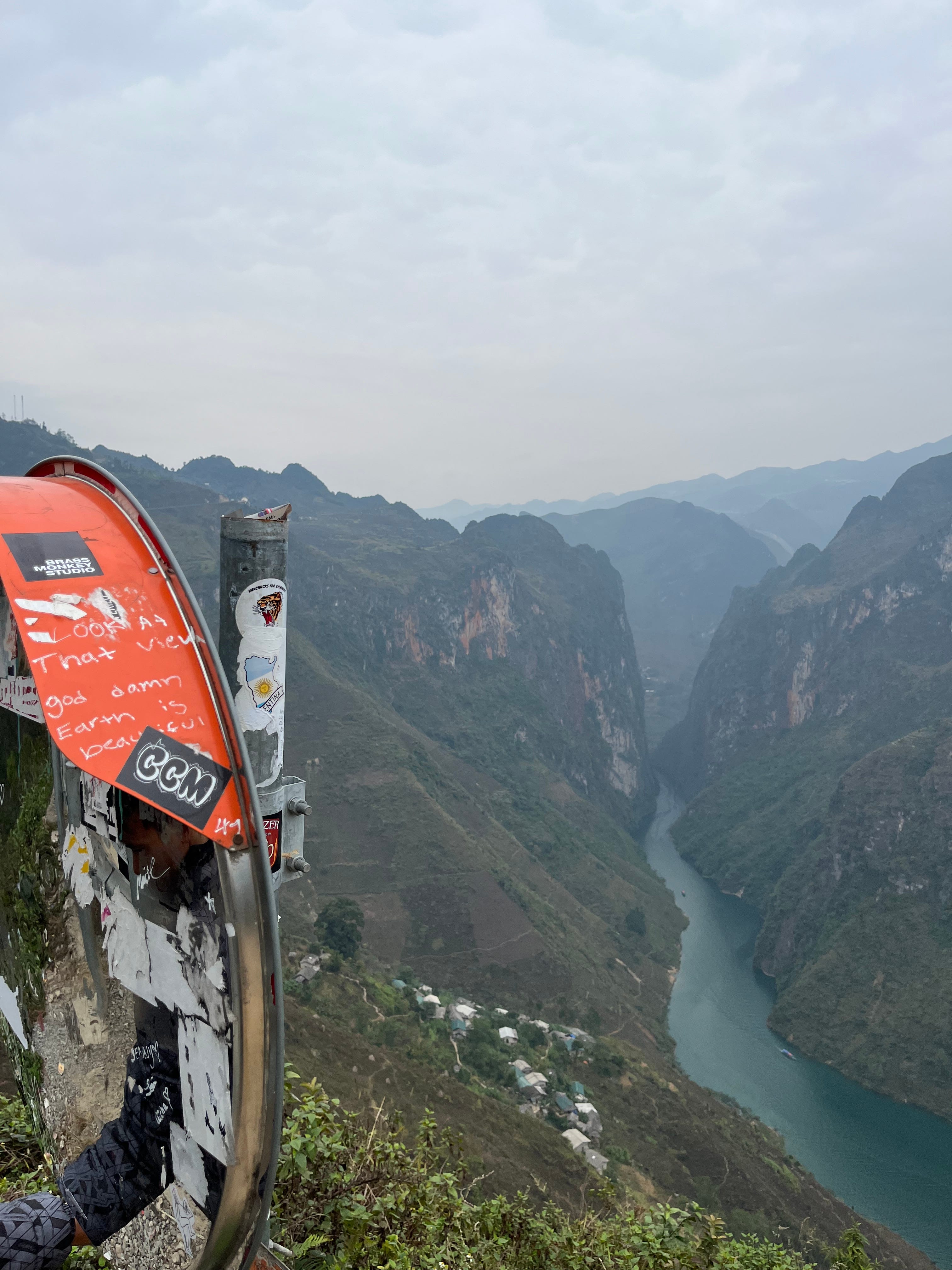
I never did exchange contact info with Neils, and I don’t know if he and I will run into each other again. But I do know that as I type this, he’s with his family in Taiwan - I hope he’s having a happy holiday. I also know that, at some point next year, I will think of Neils cooking a meal for the king in between freezing cold swims off the coast of Greenland, and hope he’s doing well. It all still counts.
On the final day, we made our way down the mountain. The third day of riding made my coccyx feel as if it could turn to dust. About five of the men on the tour spent our last stop before going back down into Ha Giang walking around in a circle, stretching out our muscles, grabbing our knees to our respective chests, and grunting. We made our way through a weekly day market, where I briefly made eye contact with a man with a severe facial deformity. I immediately assumed that it was caused by Agent Orange, even if I can’t say for certain. The entirety of North Vietnam was brutally bombed by America for years, decimating the population and causing these types of lasting birth defects.
They still like us more than the French. I don’t think that says anything about the impact the “American War” - as the Vietnamese call it - had on the country. I think it has everything to do with the brutality of the French. We are certainly graded on a curve here.

When they finally dropped us back off, we all said our farewells. I plugged my substack in the chat, promising that this post would go up that weekend (oops). They handed us all Ha Giang Loop teddy bears, and then dropped us off at the hostel in Hanoi, which was perfectly fine by me. I crawled into the bunk bed and got four hours of sleep before my early morning train to Hue.
I found my admiration and respect for Vietnam as a country only grew during my first few weeks in Vietnam, and it would continue to grow during my time in the South. Check back later this week to hear about Christmas in Da Nang and New Years in Saigon.
I learned after our trip to Ha Giang that the music the riders were playing is called Vinahouse. Steely Dan was indeed a big improvement. Safe travels on your world trip, looking forward to the next post!