"Please Don't Walk Through The Mass Grave"
Weeks 7&8: Phnom Penh, Angkor Wat, and Bangkok

CW: Description of genocide
The night before I left for Phnom Penh, I stopped by a vegan cafe in Ho Chi Minh city. Despite Google’s assurances that it was less than ten minutes away from my hostel, I spent twenty minutes on the street just wandering back and forth, trying to find it. Eventually, some locals operating a stand pointed me up a narrow staircase behind their food stall, leading to a small landing adorned with travel books in various languages and battered boxes of board games. I took a seat on a couch in front of a small coffee table and got handed a menu by the owner.
The owner was Irish born and London raised man named Keiran, and we sparked a conversation when he said how frustrated he was that he pronounced “bottle of water” like “bo’uh wa’uh.” His cat roamed around the restaurant sitting on tables, upsetting a German trio to no end. The cat eventually settled next to me as I ate vegan poutine with one hand and scratched his ears with my other.
After finishing my food, I stood up to leave.
“See you tomorrow?” he asked.
“No, I’m on to Phnom Penh tomorrow,” I said.
He laughed, and then said, “Good on you! Enjoy it, the killing fields are lovely this time of year.”
The population of the bus was a stark 50/50 split between local Cambodians returning home and young, Western backpackers. As we entered Phnom Penh, us backpackers were shocked to see how clean and developed it was. The streets were clean, the buildings were tall and broad, and the entire place felt new. Even in small things, Phnom Penh looked shockingly modern. Businesses in Vietnam often use the same faux gold lettering for their signage, but it seemed that every business in Cambodia had a custom made sign that wouldn’t look out of place in a hipster fast casual chain in America.
It was only the next day when I started to realize the cracks in the facade. Yes, the entirety of Phnom Penh felt brand new. I could just as easily say that it seemed like nobody actually lived in Phnom Penh. For a city that has over two million people in it, it felt empty. The streets were empty, a far cry from the constant hustle I felt in Vietnam. What’s more than that, the people on the street were far different from Vietnam. The streets in Vietnam were filled with merchants, swarms of motorcycles, people sitting down on little stools and eating sticky rice early in the morning. There was a real vitality to the street life in Vietnam. The people in Phnom Penh were primarily Cambodians trying to serve tourists, and secondarily the tourists themselves. There were more idle cab drivers than there were tourists to drive around. There wasn’t any real local life, at least not any I could find.
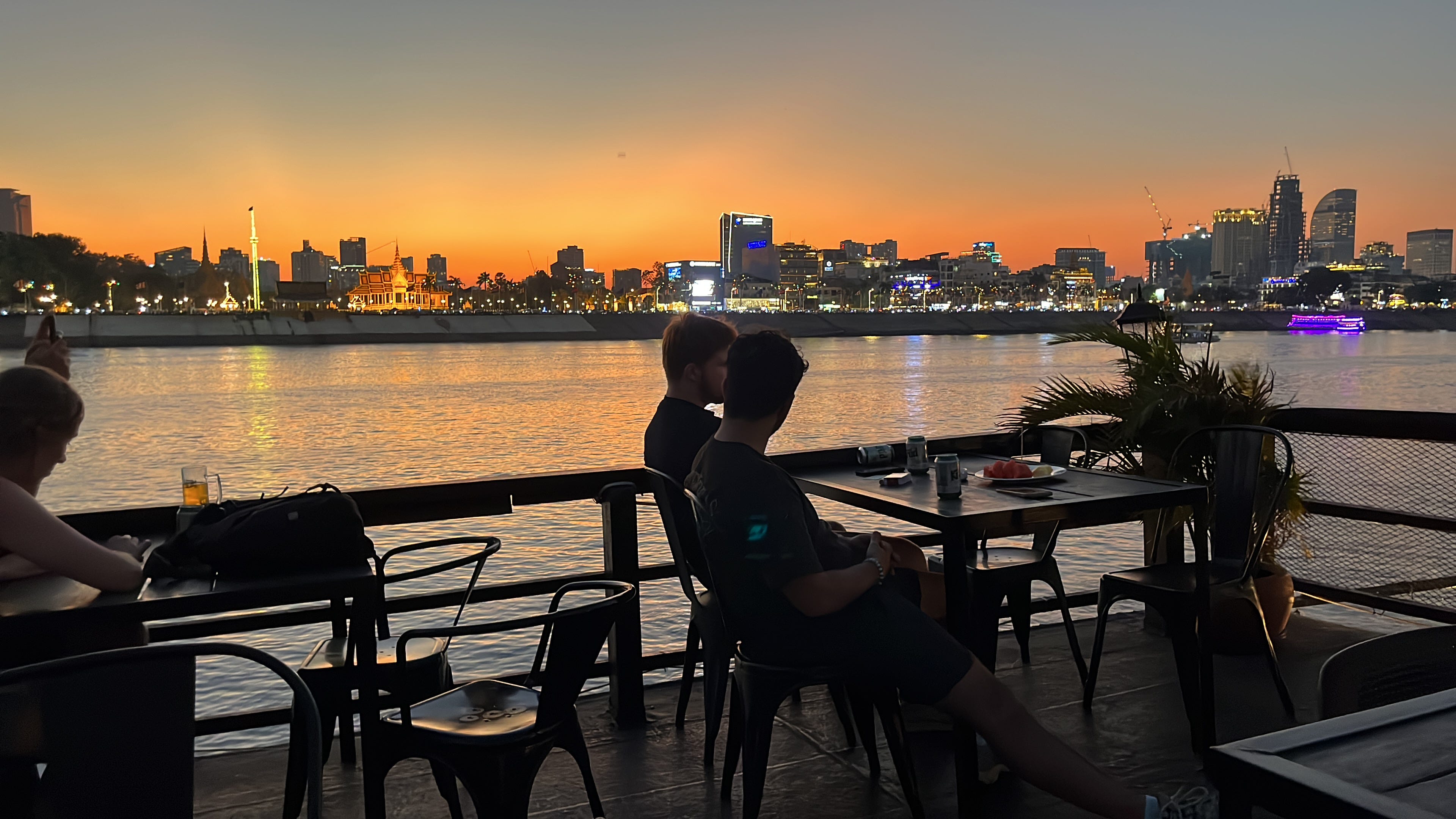
I walked down the street to a western style, self-described “flexitarian” restaurant with a mission statement about the “value of flexitarian eating”. The bottom of their mission statement, printed on the inside fold of every menu, said that they were owned by a foreign capital group. I ate guacamole with pita bread while reading up on the trade statistics of Cambodia. There are virtually no barriers to foreign investment in Cambodia. Foreign companies can own 100% of their investments in both firms and land, they don’t have to hire any local labor, and are exempt from almost every tax. The only real benefit for Cambodians seems to be the hiring of unskilled labor, a marginal benefit indeed. The sense that Cambodia isn’t for Cambodians pervaded my time there. It’s the most completely neocolonized country I’ve visited.
At least Kieran was a real human who owned a restaurant that he loved. Whatever firm that supplies the capital behind that restaurant doesn’t have any attachment to the food served there or the people who work there.
When I paid my bill, I was introduced to the last, oddest sign of how deeply Cambodia has been affected by neocolonialism: most businesses prefer purchases denominated in US Dollars. This is the only country I have ever seen where US Dollars are actively preferred over the local currency. According to several people I met, this all stems from when UN Peacekeepers occupied the country in the early 1990’s. They all got paid in US Dollars, so businesses around them started accepting US Dollars. It’s a stable currency, so they just kept using it, leading to a situation today where the Cambodian Riel is decidedly second class in its own country.
I went to a branch of the Bank of Canada and withdrew a hundred US Dollars in cash later that day. Add Canada to the list of countries with a more immediate economic presence in Cambodia than Cambodia.
If you ever go to the killing fields, as I did, here is what to expect: there is a tower of human skulls in the middle. These skulls are individually color coded to show the types of trauma inflicted. Some have dots that mark damage to their teeth, others that mark damage consistent with a pistol execution, others that mark damage consistent with a tool.
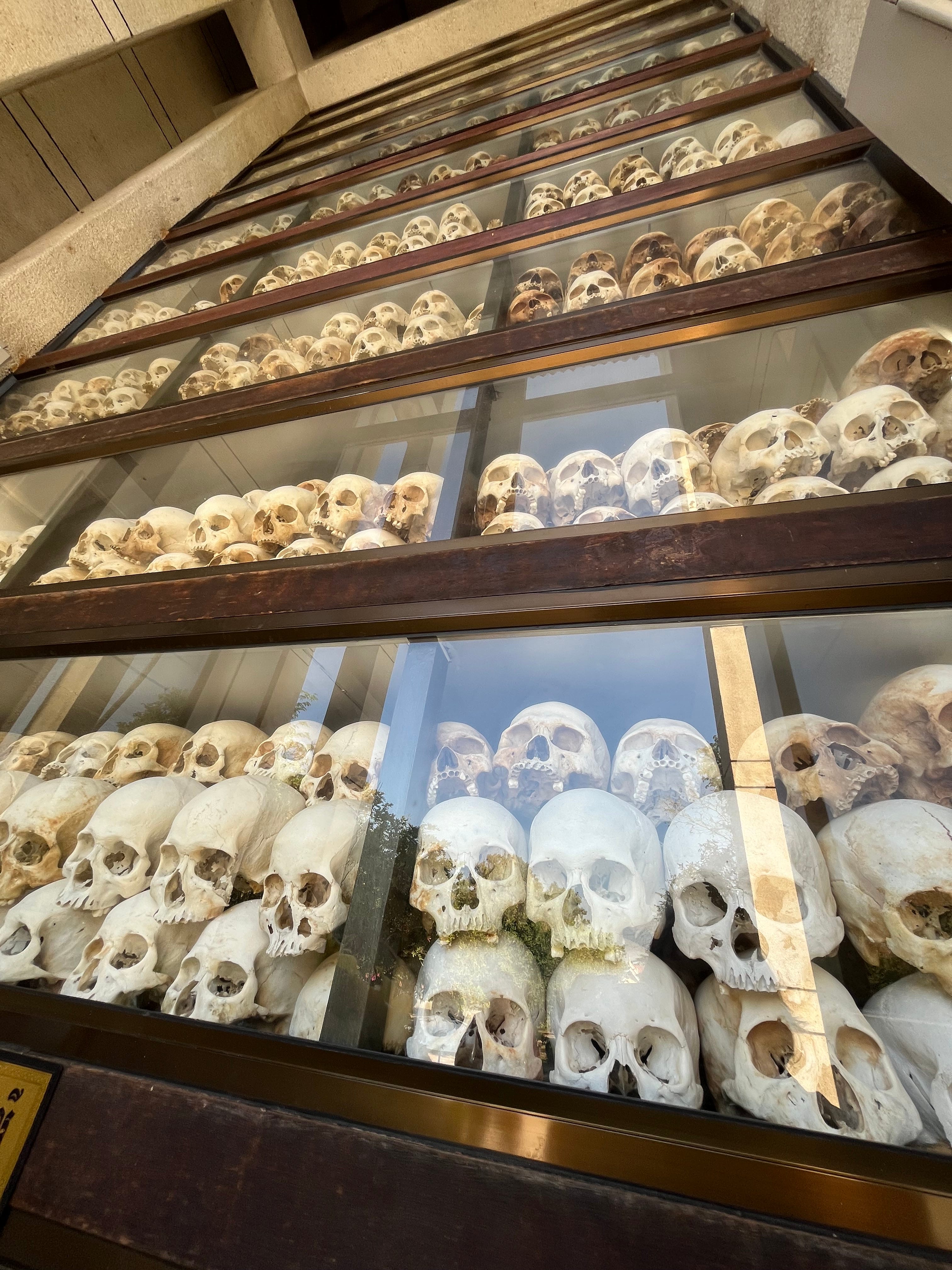
This will be before you go around the site, stepping on walkways that go above the mass graves. This is to prevent you from disturbing the largest groups of bodies, with signs above them saying, “Please Do Not Walk Through the Mass Graves.” This does not mean that you will not walk over bodies. You might notice a femur sticking out of the ground, a single tooth next to a tattered purple cloth. The Killing Fields are next to a river that floods seasonally, bringing forth new bones and new bits of clothing every season.
You’ll hear the stories of how the victims were killed, the men, the women, the babies, what implements were used for the killing, how the Khmer Rouge destroyed as much evidence as they could while the Vietnamese army moved in. You’ll stand over the largest mass grave, the one where they dumped the bodies of the soldiers who were executed for failing to repel the Vietnamese army, and picture how many bodies are beneath the soil.
You’ll probably end up going to S-21, the most infamous prison in the history of the Cambodian Genocide. The rules of the prison will be on display, including explicit instructions on how the prisoners should respond to electrocution and whippings. 20,000 people passed through the walls of that prison, and only twelve adults lived.
You might even find, in the most depressing display left, that a couple of the adult survivors are there shilling books and photo ops for $10 a pop to make ends meet. You’ll look into the eyes of a man who was tortured for years, and is now forced to spend his days at the site of his trauma selling his likeness for overeager tourists who smile broadly while taking selfies with an elderly man in decline as if he were an exhibit himself.
When my group was faced with this dilemma, we silently agreed on a compromise. I, along with a few others, bought his book. None of us took a picture with him. He bowed towards us, and we bowed back at him. The man was an artist and one of a small handful of survivors of that hellhole, he deserved better than to be paraded around for signatures and photographs like he’s a professional wrestler past his prime.
Multiple families came with us on this trip. I don’t know if they regretted their decision when we saw the femur on the ground, but they certainly regretted it when we saw the pictures taken by the Vietnamese military of the corpses left behind in S-21.
January 5th is “End of Genocide” day in Cambodia, marking when the Vietnamese forces rolled in to depose the Khmer Rouge. I was in Phnom Penh that day. There were no celebrations, no parades. The city was just a touch quieter as I walked along the waterfront.
Of course, none of this prevented the United States and China from supporting the Khmer Rouge. From the beginning of the Cambodian Genocide, the United States made it clear that they would support Pol Pot and the Khmer Rouge. In 1975, the United States Secretary of State said to the Thai Foreign Minister, “The Khmer Rouge are murderous thugs, but we won’t let that stand in our way. We are prepared to improve relations with them.” That Secretary of State was, of course, Nobel Peace Prize recipient and honorary Harlem Globetrotter Henry Kissinger. His influence extended even after Vietnam deposed the Khmer Rouge. The small Khmer Rouge government in exile controlled Cambodia’s seat in the United Nations until 1993, long after they had lost control of the country of Cambodia. It was convenient - anyone wishing to stick it to Moscow or Hanoi simply had to pledge their support to one of the most brutal killers of all time. Kissinger, of course, was also responsible for the bombing campaign during the Vietnam War that killed upwards of 500,000 Cambodians, without which the instability which led to Pol Pot would have never come to pass.
Anthony Bourdain was right. After visiting Cambodia, I want to dig up Kissinger just so I can beat him to death again.
I desperately needed a change in scenery after that tour, just to get a fresh start in Cambodia, so I changed from a hotel to a guest house after that tour. Defining a guest house against a hostel is a bit like defining pornography, you just know it when you see it. There tend to be more long term stays in them, and there is also more of a bed and breakfast feel, but all of this is pretty vague.
As far as I could tell, I was one of three guests at this guest house. One was a young Brit who had just arrived to teach English at a nearby high school. I didn’t see much of him. He was recovering from jet lag the whole time, so I mostly caught him coming and going in the wee hours of the night. The other guest was an older man, he looked like a younger Boomer, with thin white hair that reached the middle of his back in a ponytail. He always sat in the second floor common area wearing a Hawaiian shirt with the first two buttons undone, just enough that I could see how his bony rib cage sat above his beer belly. He sat there with his tablet in front of him, chatting with one of those AI girlfriend apps. He was on this app every single time I saw him, and he never did more than stare at me.
I never once heard him talk, but I did hear someone speak to him once. His room was adjacent to the common area. The thin walls provided him with no privacy, but for some reason he was taking this call on speaker phone. A woman’s voice came out, “You can’t just remark on how attractive women are. It’s making people uncomfortable. Like when you say, ‘Wow, she’s incredibly hot,' about a waitress. People hear that.”
I walked past that conversation and down the cramped spiral staircase with steps so small I could barely fit my feet on them. I bought a bottle of water and struck up a conversation with the hostel owner, Vanny, who asked me what I thought of Donald Trump. This is a common topic of conversation that I run into. I suppose being an American puts another target on my back. I’ve only met one other American backpacker in my whole time in Asia, so I suppose people really leap at the chance to discuss the situation with an American.
I told him the truth - that I was not a fan of Donald Trump and I expected his economic plans to have more negative than positive impact. He continued on, insisting that Trump would make America great again and bring American money back to Cambodia. I considered this spurious at best - I had no reason to believe that Cambodia would see any benefit from Trump, but I simply shrugged my shoulders and set out to see what I would find in the day.
“You should go up to Laos, they have opium on the barges there.”
I had been smoking Cambodian ditch weed with this British man for the last hour. Apparently this is what I would find in the day. He owned a pizza shop right next to my guest house. The night before this, I had stopped by to grab a cookie from said pizza shop before I went to bed, and struck up a conversation with his wife. She was raised outside of Siem Reap, the site of Angkor Wat, and provided for her family by hunting from the time she was a preteen. She was pregnant now, and her and her husband were expecting the baby within a couple months. She was one of a small Protestant minority in the country, and was desperately worried about the state of the business. Tourism was down, she told me, and they were constantly stressed about the business financials.
Vanny’s hopes for a Trump presidency suddenly made a lot more sense. He was just looking for something, anything, to signal a change that might help Cambodian tourism and save his business.
I had ordered breakfast from them that morning. Some of the best meals I’ve had have been completely unexpected, and that egg and cheese bagel was better than any I’ve had in New York. I chatted with him over breakfast, and, so deeply charmed by that couple, I decided to come back at night to try to get to know their story.
And now, I was smoking weed with him. Really shitty weed that he cut with cigarette tobacco, in an odd British tradition that once again makes me ask what the hell goes on in that infernal island. Nevertheless, I greatly appreciated the hospitality, even if I hardly felt a thing as I smoked.
“Not that I’m saying you should smoke opium!” he hastened to clarify, “Just that, it’s cool. It’s authentic.” He appeared to be feeling the effects of the joint far more than I was.
My curiosity got the better of me and I asked him why he thought tourism was down across Cambodia, and he grimaced.
“Well, the government doesn’t do a good job promoting it,” he said briefly, before quickly pushing on to the next topic. He was stressed by the topic, so I let it drop and asked him how he’d wound up here.
The man and his wife had led fascinating lives, the both of them. He had lived in London, New York, and came to Cambodia with an ex. They traveled through Southeast Asia together for months, until he stayed and she left. He ran a hostel on the beach for a while, and he only thought about marrying his wife after he had a seizure and he woke up to her tears landing on his face. He had won and lost multiple fortunes in his life, one lost in a fire, and now hard times had fallen on the restaurant with the downturn in tourism, but they still made it work, bit by bit.
Their stories were so grand that I almost, I am ashamed to say, thought that they were telling tall tales. I don’t think so anymore. When I stood up to pay, I left down a note that was the equivalent of $25 USD. They responded with shock and horror - I had only ordered food and drink equivalent to $12! When I insisted that I was simply offering a tip due to their incredible hospitality, they wouldn’t hear any of it and began shoveling my arms full of packaged vegan desserts to make up the difference in price. Despite my protests, they shoved me out the door with a deep thank you and many hugs. The Nutella cookies were tasty, but it also showed me their hearts - true grifters never miss a chance to make a quick buck, especially one offered up for free. The fact that they demanded a fair trade - well, I’ve often heard the adage that you’re either a grifter or a sucker. Their insistence on fairness marks them as suckers, but particularly noble suckers. The world could use more of them.
I ran into the English teacher while heading back into the guest house. He said he couldn’t sleep, I gave him my advice for getting over jet lag as well as a bag of cookies. I made my way up the cramped spiral staircase, past the room of the man with the AI girlfriend, and crashed on my bed.
A packed minivan took me to Siem Reap, the site of Angkor Wat. They put me directly behind the driver, whose seat was perched on an odd faux wood lip that made it so I couldn’t actually stretch out my legs for any part of the six hour ride to Siem Reap. I was curled up in the fetal position, flexing my legs to try to keep circulation. By the time I finally did get out my coccyx was pulsing with pain.
I’ve written the word “coccyx” more in the last three weeks than I have in the twenty six years prior to those two weeks. If anyone has any clue what this means, please, let me know.
Siem Reap is a tourist town. I don’t think that there’s a single industry there other than tourism, and the only cause for tourism is the Angkor Wat complex. Again, I could feel the desperation caused by the tourism dip in Cambodia. About half the people I ran into there told me with varying degrees of desperation, “America is a great country! Go home, tell your friends how beautiful Cambodia is!” In fairness, reader, I will tell you that Cambodia is beautiful, and I will also lament that it hasn’t been allowed to chart its own course in the last century or in this one.
I woke up early for a pre-dawn ride to Angkor. Tourists from all over the world gathered around the reflecting pools in front of Angkor just to get a chance to see the sunrise. The pale blues and silken yellows of the early Cambodian morning looked gorgeous as they bounced off the surface of the water. The only problem was that the reflecting pools are much smaller than they appear in photographs.
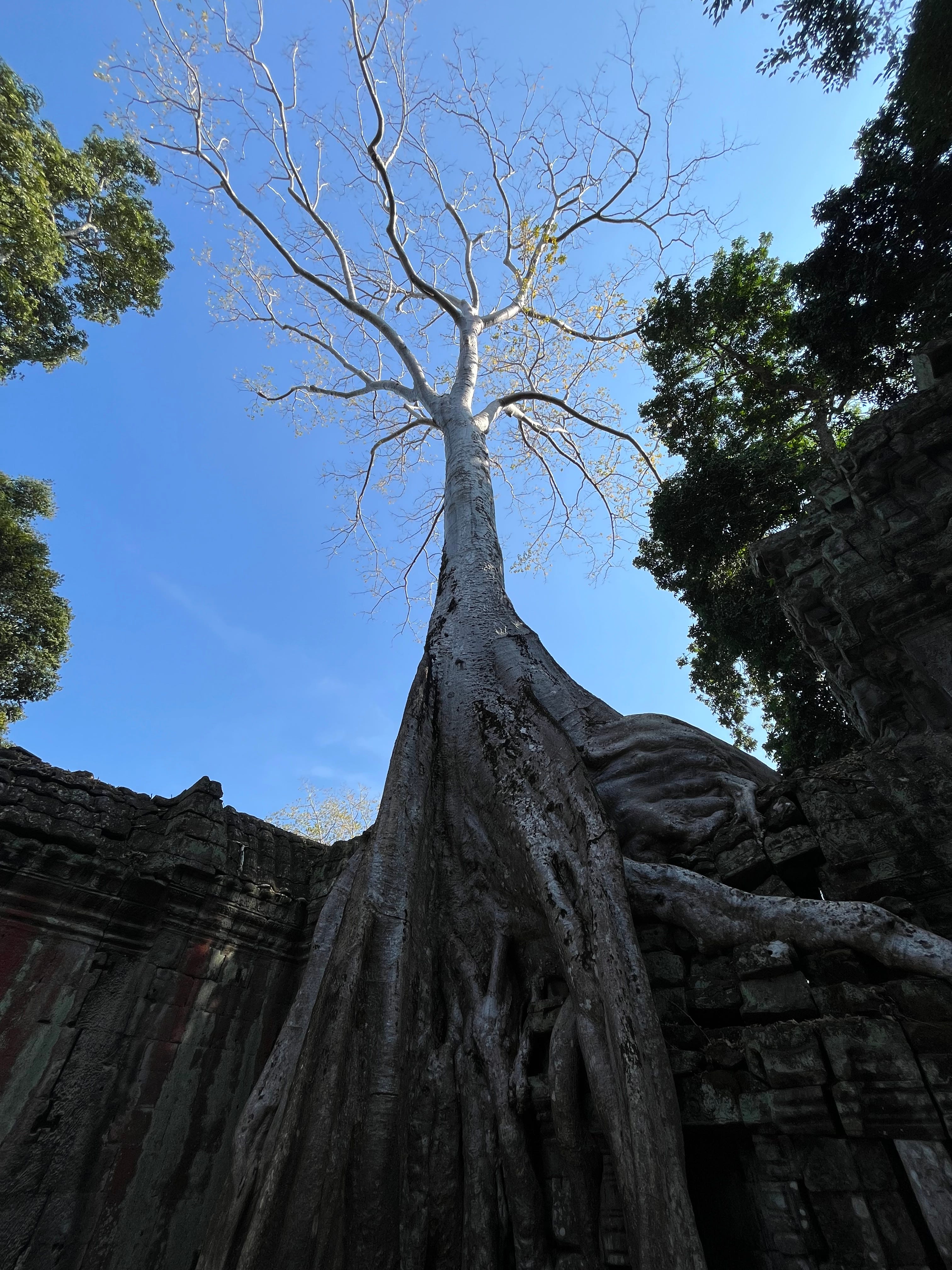
A local guided me through the complex as the sun raised further and further into the sky. The entire complex of temples known as Angkor Wat is breathtaking, but the largest one, the one that I was at in the early morning, is specifically the old capital of the Khmer empire - Angkor. The spindles of the structure are exactly aligned with the cardinal directions, which is an almost unthinkable achievement for a site that began construction in the 9th century. The steps were intentionally hard to climb, to mimic how hard it is to step up and achieve Nirvana, but the steps that were only meant to be climbed by the king were easy. The king’s easy glide up the steps must have been comforting to some and infuriating to others. Gorgeous Hindu-Buddhist murals cover the exterior walls, telling stories of mythical and historical conquest. My guide pointed out an army bowing to the king, their hands pressed together in front of their chests as they bend.
“The people, they bow close to the chest for friends, below the head for family, at the head for the king, and above the head for the Buddha,” he said, moving his hands through the positions.
I’ve been going to church on this trip, at least as much as I’ve been able to. That night, after my tour of the entire complex, I went to evening services. I find it interesting to see how the services differ and stay the same - for example, in Vietnam I learned that Vietnamese priests can offer up long, rambling homily’s without a point just as well as American priests can. This church was far smaller, with no pews and simple mats on the floor. I’d estimate that only half the congregation actually lived in Cambodia, and maybe only half of those were Cambodians. Most of the congregation that night were tourists seeking some spiritual guidance, or maybe even just a sense of normalcy.
When people bowed at church that night, the Westerners, Koreans, and Japanese members of the congregation bowed as I had seen many times before in church, with the head drooping slightly at designated marks during the presentation of the Eucharist. The Cambodians would bow deeply, their hands going above the head, just as they did for the Buddha.
The morning I left Siem Reap, I grabbed a remorque (a sort of cushioned carriage pulled by a motorcycle) down to the bus depot. The bus left at 8:00 AM, but I hadn’t yet been on a bus in Southeast Asia that had left on time. My 8:03 estimated arrival time, I thought to myself, provided more than enough wiggle room to ensure that I’d be headed to Bangkok. As the remorque pulled up, I saw a fire engine red double decker bus pulling out of the station. The remorque slowed down and I vaulted out of it, sprinting after the bus as it began pulling away, waving my hat and screaming like an old west prospector trying to stop a carriage. The employees at the station joined in, banging on the sides of the bus and screaming in Khmer. The bus came to a halt, finally, and the driver poked out his head with a confounded expression.
“Going to Bangkok?” I offered. He sighed and nodded his head.
The side door slid open, and the stewardess poked her head out.
“Do you have a ticket?” I pulled up my phone to show her, but she hushed me before I could speak. “Go and get your ticket printed at the counter, be ready to show them your passport.”
She paused for a second and gave me a look. “You are very lucky,” she said, “now hurry up.”
Thailand loves their monarch. That is the official story.
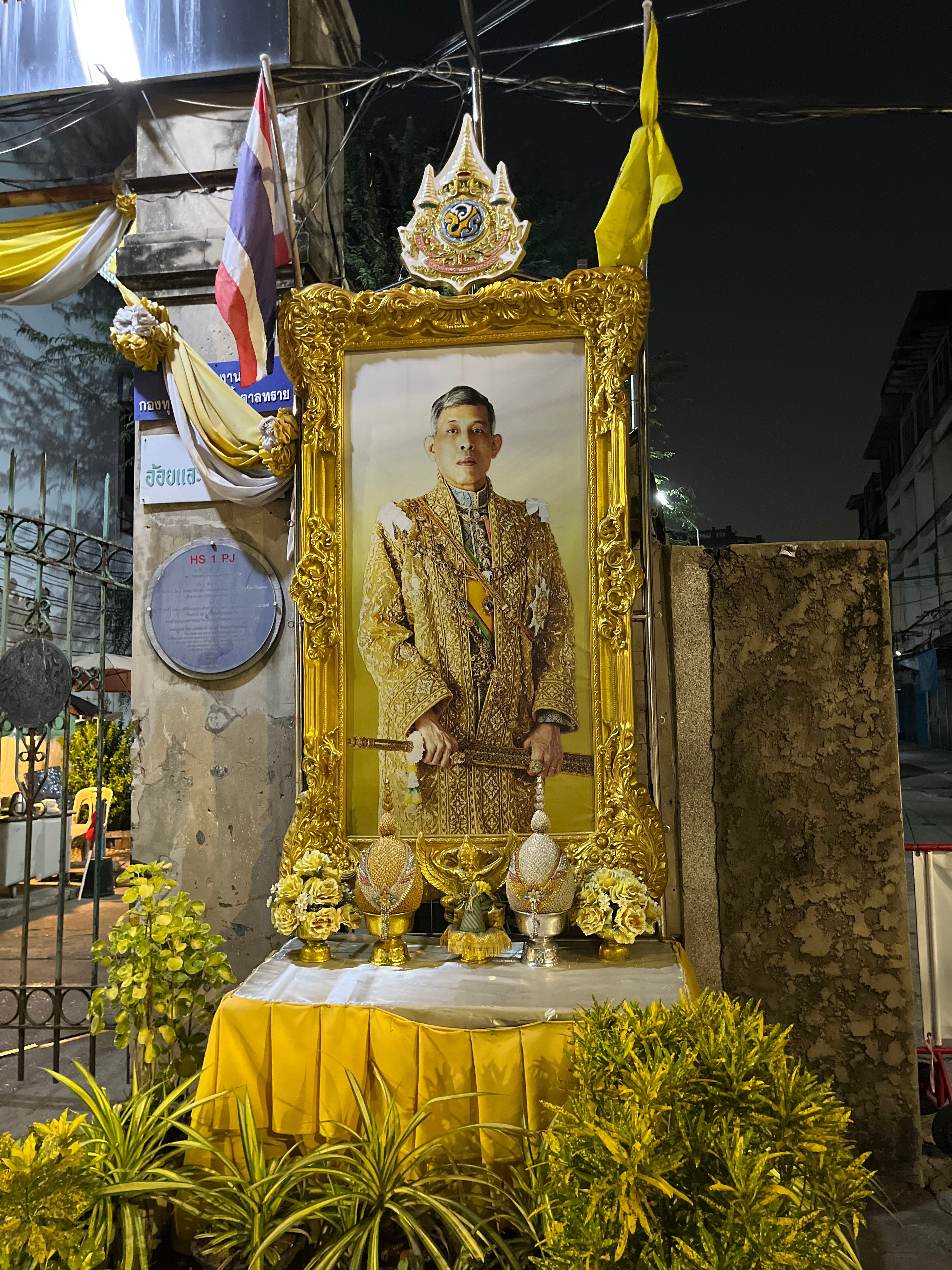
Stepping off the bus in Bangkok, next to a potentially defunct rail museum, I was immediately greeted by multiple massive pictures of King Rama X all around me. There are a variety of portraits, but the most common one, the one that I see when I picture them in my mind, is of Rama X wearing a golden coat, holding a sheathed sword at his side. Almost every Thai flag is accompanied by a flag of the royal family’s crest, and every dollar has a picture of King Rama X on it, although I found a couple that had pictures of his father King Rama IX as well. Thailand will not let you forget that it is a kingdom. There is some definite pride in the unbroken lineage of the royalty, pride that is tied in with Thailand’s history as the only uncolonized nation in Southeast Asia. Still, it’s odd to be in a country where the monarchy is announced so much - even in Japan, the Imperial family is offered less attention and adulation.
My hostel was clean, quiet, and modern. The upside of a quiet hostel is that you aren’t surrounded by two for one beer promotions and people taking advantage of said promotions while you’re trying to go to sleep. The downside of a quiet hostel is that socialization in a hostel appears to be an on-off switch: either everyone is drinking, socializing, and drunkenly saying how much they love someone they met in the last thirty minutes, or everyone keeps to themselves. They need to invent a hostel where people just chill out together, but that appears to exist beyond our current understanding of science.
There was exactly one half of one common area where you could chill with others in that hostel - a covered part of the rooftop with a table. I was up there to watch the sunset, and two other men sat down.
“You need to be careful with how many pictures you take brother, don’t forget to experience it yourself,” said one of them - a tall, lanky man with a mass of loose curls that dropped from his head. I wasn’t sure if I should be annoyed with him for policing my shit or if I should appreciate that what he said was sound advice that I generally agree with.
I sat down with him and began to exchange stories. His name was Ama, he was cycling around the world, and had already cycled through wild locations that I had not even remotely considered traveling to. I wouldn’t fly into Tajikistan and he’d already cycled the length of the whole country. His deepest held belief, that he espoused frequently, was that people deserve to be judged on their own merits, not the merits of their country. It’s a wise sentiment, even if I occasionally struggle when it comes to applying that to the English.
On a hot day in Bangkok, I went to see a movie to blow off the heat. I appreciated that the ticket was just $10 - shopping in Thailand feels like you’re shopping in 1997. In an IMAX theater, between the trailers and the feature, they played a salute to His Majesty, King Rama X. In between soft focus pictures of him in military apparel, wearing kingly regalia, and even appearing next to his current wife, paragraphs showed up on the screen celebrating his accomplishments. However, they were all in Thai. I amused myself by guessing the meanings of the numbers that popped up on screen. It looked something like this:
สวัสดี จริงๆ แล้วนี่ไม่ใช่ข้อควา 1.5x มเกี่ยวกับกษัตริย์ในภาษาไทย
นี่เป็นเพียงการ 3,000 แสดงภาพตลกสำหรับผู้พูดที่ไม่ใช่ชาวไทย
หากคุณพูดภาษาไทยได้จริ 270,000 งและกำลังอ่านข้อค23วามนี้อยู่ สวัสดี!
ขออภัยที่ฉั 4 นใช้การแปลของเครื่องมือค้นหาสำหรับบิตนี้ หากคุณใช้การแปลอัต
1,500,000 โนมัติเพื่อทำความเข้าใจสิ่งนี้ ก็สวัสดีเช่นกัน ฉันแค่อยาก
ให้คุณเข้าใจว่าฉันประทับ174ใจคุณน้อยกว่าคนที่เข้าใ66จภาษาไทยจริงๆ
To this day, I’m still not sure what the 1.5x could have stood for. The only part in English was a translation of the text of the first slide, asking everyone to stand and honor Rama X. There were at least forty people in the theater. I don’t think anyone stood up.
Except for me, of course. I love King Rama X and strictly abide by the Lese-Majeste laws of the Kingdom of Thailand.
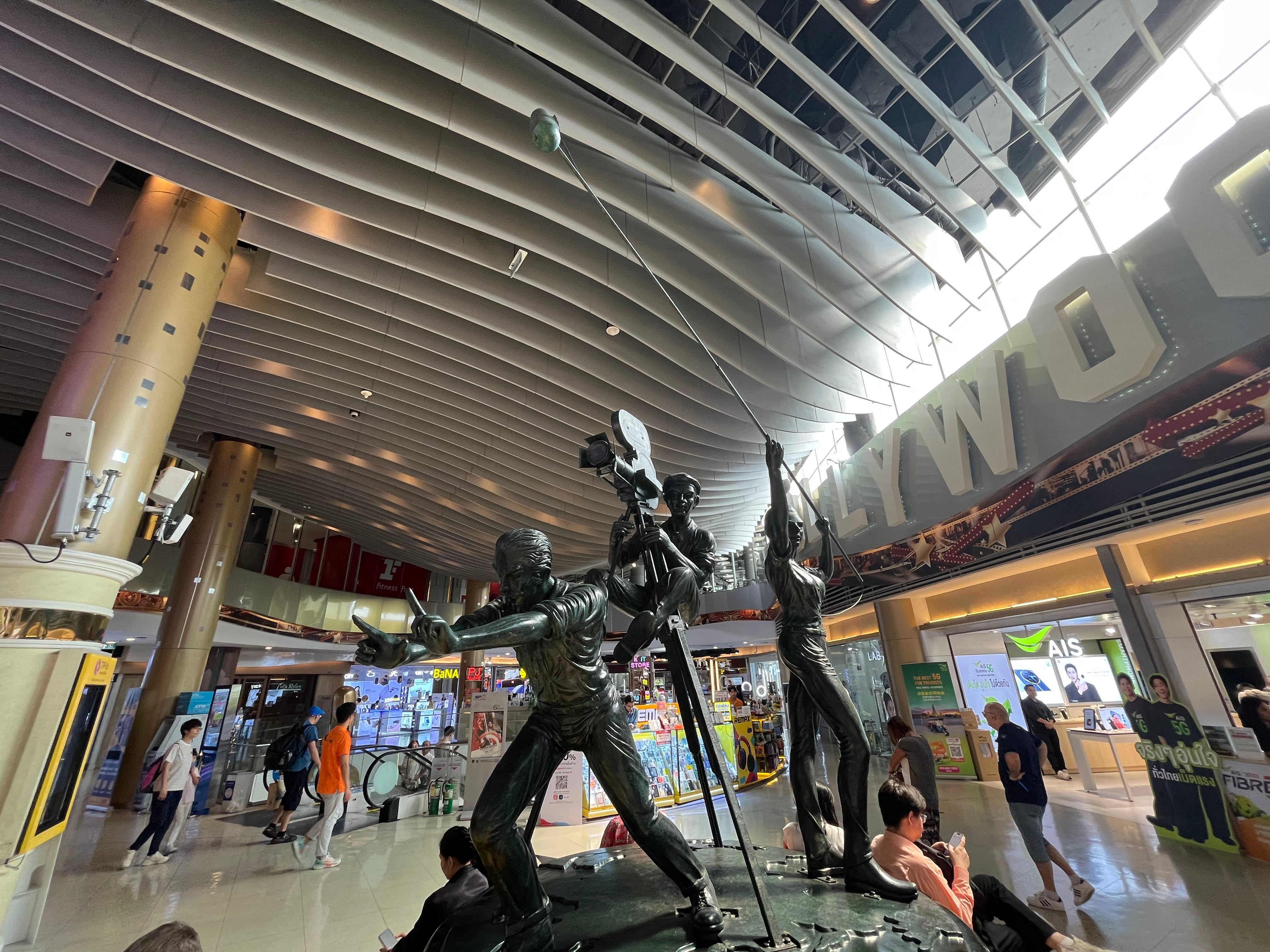
Truth be told, I spent a lot of time in malls in Thailand. I say malls because I think there were multiple malls I went to, but there may have just been three malls that were all linked together. Perhaps two of them are linked and the other one is just across the road, I’m not quite sure. What I am sure about is that all of them were focused on selling an experience of luxury, which directly translated to Western luxury. Most of the celebrities used to sell the items are even the same - Anne Hatheway, Sydney Sweeney, Johnny Depp.
Most interesting was the mall across the road, which had an international travel theme. Every floor was themed after a great global city: Paris, San Francisco, Istanbul, London, Tokyo, and Movies. Each escalator was labeled “Arrival” and “Departure”, and each floor had some imagery related to the city. San Francisco had trolley lines on the ground, for example. Istanbul, in a much harsher condemnation of Turkey than even the most stringent Armenian nationalist could come up with, only had a statue of Ataturk, while the rest of the floor was covered in Japanese spillover from the Tokyo floor. They had more sushi places in Istanbul than gyro places, and I’m sure that Auntie Anne’s doesn’t have roots in Turkey. I wonder why they bothered to have an Istanbul floor at all - was Cairo busy that day?
“You should go on the jungle cruise to Lao,” said Ama. We were both headed out of the hostel on the same night - he was shipping his bike to Switzerland to try to get a job for a few months to fund his travel, I was headed north to Chiang Mai.
“But try to get the calmer ones,” he continued, “The party boats are... simply too much.”
I thought back to the Englishman in Cambodia who told me about the opium boats. Then I thought even further back, to my parents telling me about the time they accidentally boarded a Thai party boat instead of a sightseeing boat only to see a man’s leg crushed by an anchor.
“Duly noted, I don’t think that party boats are really my style,” I said.
We hugged goodbye. As he turned to leave, he caught a glimpse of the bag my food delivery came in.
“Ah! Pimp my salad! Like “Pimp My Ride”! Brother, that is so funny,” he said, smiling. He grabbed his camera and took at least seven photos of the bag, then walked out the door. I followed suit soon afterwards, boarding my bus to Chiang Mai.